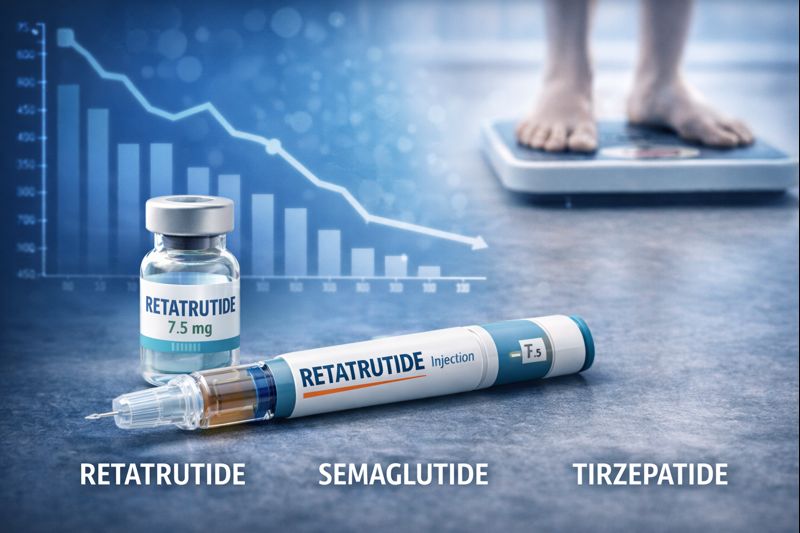
Retatrutide is gaining strong attention in the medical weight loss community due to its exceptional early study results. As a next-generation triple-agonist therapy, it aims not only to reduce appetite but also to increase energy expenditure and improve metabolic health.
In this article, we explore what kind of weight loss results may be expected with Retatrutide, based on currently available clinical research and expert interpretation.
Why Retatrutide May Produce Greater Weight Loss
Retatrutide differs from earlier medications because it activates three hormonal receptors at once:
- GLP-1: reduces appetite and food intake
- GIP: supports insulin function and satiety
- Glucagon: increases calorie burning and fat utilization
This combined mechanism targets both sides of the energy balance equation: calories consumed and calories burned.
Weight Loss Results Observed in Clinical Studies
Early-phase clinical trials have shown that participants using Retatrutide experienced substantial reductions in body weight over the study period.
Key observations include:
- Significant average weight loss compared to placebo
- Consistent fat loss across different starting body weights
- Progressive results over several months rather than rapid rebound
In some studies, participants achieved double-digit percentage weight loss, placing Retatrutide among the most promising investigational obesity treatments to date.
How Fast Does Weight Loss Occur?
Weight loss with Retatrutide typically follows a gradual and sustained pattern:
- Initial weeks: appetite reduction and early weight changes
- Months 2–4: steady fat loss as doses are optimized
- Longer-term use: continued weight reduction and stabilization
This gradual progression helps support better tolerability and long-term adherence.
Factors That Influence Individual Results
Weight loss outcomes may vary depending on several factors:
- Starting body weight and metabolic health
- Dose escalation schedule
- Diet quality and calorie intake
- Physical activity level
- Consistency with weekly injections
Individuals who combine Retatrutide therapy with structured lifestyle changes tend to experience the most favorable results.
Retatrutide vs Other Weight Loss Medications
When compared to established treatments:
- Retatrutide may outperform GLP-1–only therapies
- Results may exceed those seen with dual-agonist medications
- The glucagon component may reduce metabolic slowdown
This positions Retatrutide as a potential future option for individuals who did not achieve desired outcomes with earlier therapies.
Is the Weight Loss Sustainable?
Sustainability is one of the most important considerations in obesity treatment. Retatrutide’s multi-pathway action may help:
- Reduce adaptive metabolic slowdown
- Support long-term appetite regulation
- Improve metabolic flexibility
However, like all medical weight loss therapies, continued use and lifestyle support are critical for maintaining results.
Important Considerations
- Retatrutide is still under clinical investigation
- Long-term outcome data are still being collected
- Results may differ outside controlled study environments
All treatment decisions should be made in consultation with a qualified healthcare professional.
Final Thoughts
Current research suggests that Retatrutide has the potential to deliver some of the strongest weight loss results ever observed in injectable obesity treatments. Its unique triple-agonist approach may redefine expectations for medical weight loss once development is complete.
For individuals seeking science-based, future-focused solutions, Retatrutide represents a major step forward.
This article is for informational purposes only and does not constitute medical advice. Always consult a qualified healthcare professional before starting any weight loss therapy.